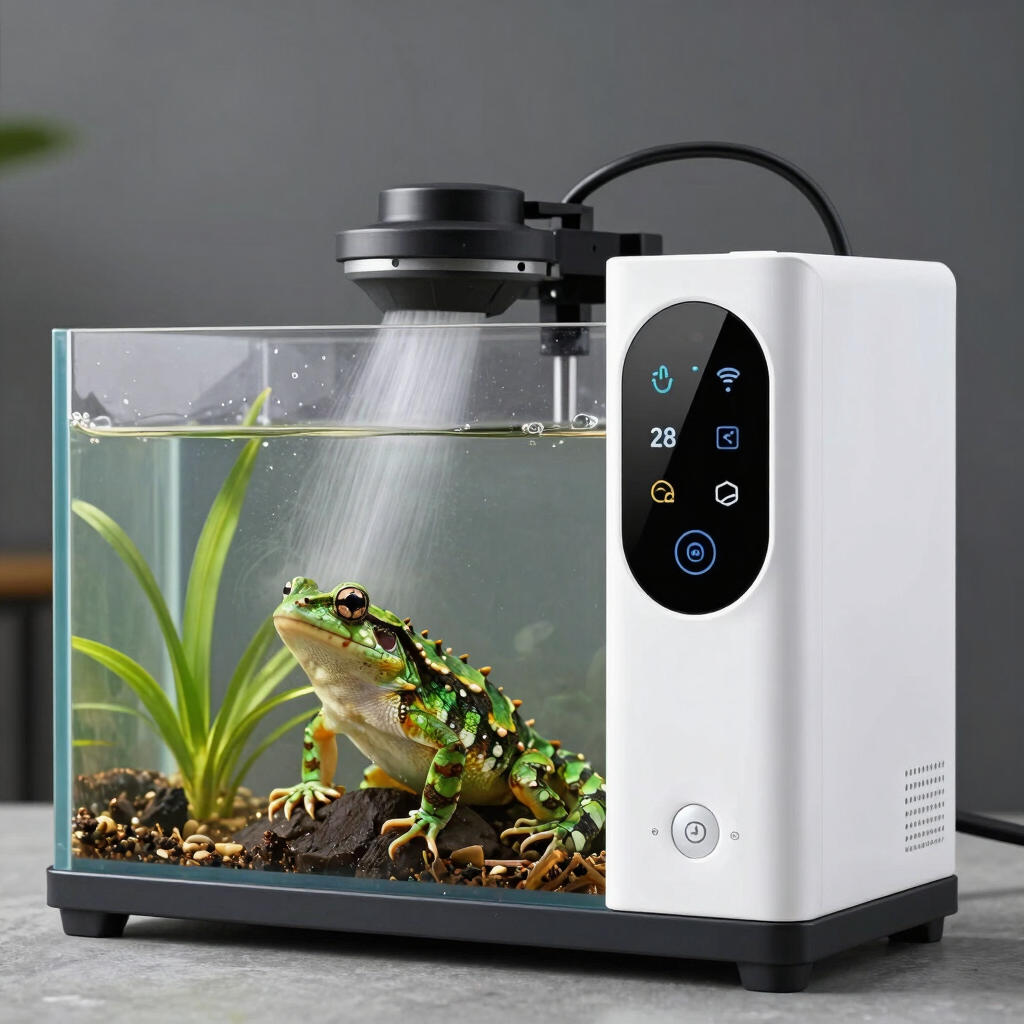
Automated Terrarium Misting Systems for Reptiles

Discover how automated terrarium misting systems maintain optimal humidity for tropical reptiles, ensuring healthy shedding and hydration. Learn which species benefit most and how to choose the right setup for your pets.

REPTILES & AMPHIBIANS

JaMarcus Smith Pet Ecosystem Team

5/19/202612 min read

Automated Terrarium Misting Systems for Tropical Reptiles: Complete 2026 Guide

Humidity failure is the most common environmental cause of illness in captive tropical reptiles — and it's almost entirely preventable. A chameleon kept at 40% ambient humidity instead of its required 70–80% will begin showing dehydration, impaired shedding, and respiratory stress within days. The frustrating part is that maintaining correct humidity isn't biologically complex — it just requires consistent, timed misting that most keepers can't reliably deliver manually.

Automated terrarium misting systems solve this with programmable precision: the right amount of water, at the right times, distributed evenly across the enclosure — without any manual intervention. This guide covers why humidity precision matters at the species level, how misting systems work mechanically, which features actually matter, and how to choose and set up the right system for your specific enclosure.

Why Humidity Is a Biological Requirement, Not a Preference

Tropical reptiles and amphibians evolved in environments where atmospheric moisture is constant and predictable. Their physiology reflects this — they haven't developed the same water conservation adaptations as desert species, and they depend on environmental humidity for functions that other reptile keepers sometimes take for granted.

Hydration: Many tropical reptiles drink primarily from water droplets on leaves and enclosure surfaces rather than from standing water dishes. Chameleons are the most well-documented example — most individuals in captivity will not reliably drink from bowls and depend almost entirely on misting-generated droplets for water intake. Insufficient misting in a chameleon enclosure is a direct cause of chronic dehydration, even when a water dish is present.

Thermoregulation: Evaporative cooling from the skin surface plays a role in temperature regulation for many tropical species. Dry conditions force some species into less active thermoregulatory behaviors as their primary cooling mechanism becomes impaired.

Ecdysis (shedding): Proper shedding requires adequate skin hydration. Dysecdysis — incomplete or retained shed — is among the most common veterinary presentations for captive reptiles and is almost always linked to insufficient humidity during the shedding cycle. Retained shed on digits (toes) is particularly dangerous, as it constricts blood flow and can result in tissue necrosis requiring amputation.

Respiratory health: Low ambient humidity dries out mucous membranes in the respiratory tract. For species susceptible to respiratory infections — particularly chameleons and dart frogs — chronically dry conditions lower immune resistance and increase infection risk significantly.

Humidity Requirements by Species

Getting the humidity range right requires knowing your specific animal's native habitat conditions, not a generic "tropical reptile" target:

  • Veiled chameleon — Requires 50–70% daytime humidity and 80–100% overnight humidity. Heavy misting 2–4 times daily is critical because they primarily drink water droplets from leaves and surfaces.

  • Panther chameleon — Thrives at 60–80% daytime humidity with 90–100% overnight humidity. Mist 2–4 times daily while allowing a slightly drier midday period.

  • Jackson's chameleon — Needs 50–80% humidity with misting 2–3 times daily. Cooler enclosure temperatures are especially important alongside proper humidity.

  • Crested gecko — Prefers 60–80% humidity with 1–2 misting sessions daily. Allow the enclosure to partially dry out between cycles.

  • Day gecko — Maintains good health at 60–80% humidity with light misting 1–2 times daily. Excessive moisture can contribute to respiratory problems.

  • Dart frog — Requires near-constant 80–100% humidity with multiple misting sessions or continuous fogging. One of the most humidity-sensitive commonly kept amphibians.

  • Green tree frog — Does well at 60–80% humidity with 1–2 misting sessions daily and can tolerate brief humidity fluctuations.

  • Red-eyed tree frog — Needs 70–100% humidity with 2–3 misting cycles daily. Humidity peaks at night, while a mild daytime dry period is acceptable.

  • Anole — Prefers 60–80% humidity with twice-daily misting. Maintaining a humidity gradient by misting only one side of the enclosure is beneficial.

  • Basilisk — Requires 70–80% humidity with misting twice daily. Large enclosures often need multi-nozzle misting systems for proper coverage.

Humidity gradients matter as much as averages. Most tropical species benefit from a humidity gradient — higher moisture at one end or in the lower canopy of the enclosure, with a drier basking area. This allows the animal to behaviorally regulate hydration exposure, just as they would in a natural rainforest canopy where sun-exposed upper branches are drier than shaded lower vegetation. A single humidity reading in the middle of the enclosure tells you little about the range your animal is actually experiencing.

Why Manual Misting Fails at Scale

A spray bottle works for a single small enclosure with a tolerant species. It fails as a humidity management strategy for three fundamental reasons:

Temporal consistency. Humidity in a closed terrarium spikes immediately after manual misting then drops steadily as moisture evaporates and substrate absorbs it. The humidity cycle from a single manual spray typically returns to pre-mist levels within 1–3 hours depending on enclosure ventilation and substrate depth. Maintaining a chameleon at 70% humidity with manual misting requires 4–6 misting sessions per day — a realistic commitment for perhaps 5% of keepers over the long term.

Distribution uniformity. Spray bottles saturate the area nearest the keeper while leaving the back and upper areas of a tall enclosure largely dry. In screen-sided chameleon enclosures where misting coverage is particularly important, this creates significant humidity variation across the space the animal actually uses.

Accountability gap. Manual misting requires remembering to do it. Work schedules, travel, illness, and distraction create gaps. A single 24-hour period without misting in a dry climate can produce visible dehydration signs in chameleons. Automated systems have no equivalent failure mode — they run on a programmed schedule regardless of the keeper's circumstances.

How Automated Misting Systems Work

A reptile misting system has four core components:

Reservoir: A 1–5 gallon water container (depending on system scale) that holds the supply. Reservoir capacity determines refill frequency — a single-enclosure system running 4 short daily cycles may go 2–4 weeks between refills; a multi-enclosure breeder setup may need weekly refilling.

Pump: High-pressure pumps (typically 80–100 PSI in premium systems) generate the pressure needed for micro-misting — droplets fine enough to remain suspended in the air and coat leaf surfaces evenly. Low-pressure pumps produce larger droplets that create puddles and saturate substrate rather than distributing moisture through the air column. Pump quality is the most significant differentiator between entry-level and premium misting systems.

Tubing and nozzles: Flexible polyurethane tubing routes water from the pump to adjustable nozzles mounted inside or above the enclosure. Nozzle placement determines coverage. Most nozzles are adjustable from a wide fan spray to a focused stream — fine-tuning nozzle angle during initial setup determines whether the system soaks the substrate or mists the full enclosure volume.

Timer/controller: The brain of the system. Basic systems use digital countdown timers. Advanced systems (Mist King, Reptile Basics Pro, Exo Terra Monsoon RS400 Pro) use programmable multi-cycle timers allowing independent control of misting duration and frequency for each time block throughout the day. The most sophisticated systems integrate hygrometer sensors — if the enclosure reaches target humidity, the scheduled misting cycle is skipped; if humidity drops below threshold, an unscheduled cycle triggers automatically.

🏆 Pet Ecosystems Top Pick Automated Misting System

🌫️ Best Automated Misting System

MistKing Ultimate Misting System (5th Gen)

👉 Check Today's Price on Amazon

✅ Used by Zoos & Breeders
✅ Expandable to 20 Nozzles
✅ Ultra-Fine 50 Micron Mist
✅ Ideal for Chameleons, Dart Frogs & Bioactive Terrariums

High-Pressure Micro-Misting vs. Ultrasonic Foggers: Key Difference

These two technologies are frequently confused, and the difference matters substantially for reptile health:

High-pressure misting systems push liquid water through a fine nozzle under pressure, breaking it into very small droplets (50–100 microns). These droplets coat surfaces, provide drinkable water for chameleons and other species that drink from droplets, and evaporate relatively quickly to raise ambient humidity without excessive substrate saturation.

Ultrasonic foggers use a vibrating piezoelectric disc to convert water into a visible cold mist or fog. The particles are extremely small (1–10 microns) and remain suspended as visible fog. This produces dramatic visual effects and raises humidity readings rapidly — but doesn't provide the surface droplets that chameleons drink from, and the ultra-fine fog can carry mineral deposits from tap water into the respiratory tract of sensitive species. Most reptile veterinarians advise against ultrasonic foggers as primary humidity tools for chameleons specifically, though they can supplement a misting system for certain species like dart frogs.

For the majority of tropical reptile applications, high-pressure misting is the correct technology. Foggers are appropriate as supplements for extreme humidity species (certain dart frog species, some Uroplatus leaf-tail geckos) where near-100% ambient fog is the target.

Top Automated Misting Systems for Terrariums in 2026

Mist King Ultimate — Best Overall for Serious Keepers

Best for: Chameleons, dart frogs, multi-enclosure setups, bioactive builds Pump pressure: High (100 PSI) Reservoir: External (uses any bucket or container up to 5 gallons) Nozzle capacity: Expandable — up to 20 nozzles Timer: Advanced programmable with multiple independent cycles Humidity sensor integration: Yes (with optional sensor add-on) Price range: $150–$200 for starter kit; expandable

The Mist King is the benchmark system in the reptile hobby, used by professional breeders, zoos, and serious private keepers. Its high-pressure pump produces genuine micro-misting droplets, the programming is flexible enough for the most demanding species schedules, and the modular nozzle system allows expansion to any number of enclosures. The external reservoir is a practical advantage — you can use any food-safe container, including gravity-fed systems for continuous supply.

The initial cost is higher than entry-level options, but the Mist King's pump reliability and component quality mean it typically lasts years in continuous operation without maintenance issues.

Exo Terra Monsoon RS400 Pro — Best for Single Enclosures

Best for: Single terrarium use, beginners, moderate humidity species Pump pressure: Medium Reservoir: Built-in 1.5-liter tank Nozzle capacity: 2 nozzles included Timer: Programmable with 2 daily cycles Price range: $80–$110

The Monsoon RS400 Pro is the most user-friendly entry point into automated misting. The integrated reservoir removes the need to source and connect a separate container, setup takes under 30 minutes, and the included dual nozzle configuration covers most standard-size single enclosures adequately.

Its limitations are real for demanding applications: the medium-pressure pump produces larger droplets than high-pressure systems, the 1.5-liter reservoir needs frequent refilling for high-frequency misting schedules, and the 2-cycle timer is insufficient for chameleons needing 4+ daily sessions. For crested geckos, anoles, tree frogs, and other moderate-humidity species on a 1–2 daily misting schedule, it's a capable and affordable solution.

Reptile Basics Pro Series — Best Budget High-Pressure Option

Best for: Single to dual enclosures, intermediate keepers Pump pressure: High Reservoir: External (1–2 gallon included) Nozzle capacity: 2–4 nozzles Timer: Programmable multi-cycle Price range: $100–$130

The Reptile Basics Pro offers genuine high-pressure performance at a lower price point than the Mist King. It's the strongest option for keepers who need micro-misting quality for a single chameleon or dart frog enclosure but don't need the Mist King's multi-enclosure scalability. Build quality is solid, the pump runs quietly, and the timer programming is more flexible than the Exo Terra Monsoon.

Smart Misting Integration: Humidity Sensor Control

The most advanced misting configurations add a hygrometer-integrated controller — a humidity sensor placed inside the enclosure that communicates with the misting system to create a feedback loop:

  • Target humidity set to 75%

  • Sensor reads current humidity at 65%

  • Controller triggers a misting cycle to raise humidity

  • Sensor confirms humidity has reached 75%

  • Next scheduled cycle proceeds normally; unscheduled cycles fire as needed between schedules

This approach is particularly valuable for enclosures in environments where ambient room humidity varies significantly — air-conditioned rooms in summer, heated rooms in winter, or coastal versus arid inland climates where background humidity differs enough to affect enclosure conditions.

The Inkbird IHC-200 ($35–$45) paired with a smart outlet is a cost-effective way to add sensor-based control to any misting system that doesn't include native sensor integration. For chameleon keepers especially, the combination of a programmable misting system and sensor-based override is the current standard of care.

🌡️ Best Temperature & Humidity Controller

Inkbird ITC-308 + IHC-200 Controller Bundle

👉 Check Today's Price on Amazon

✅ Automated Heat & Humidity Control
✅ Ideal for Tropical Reptiles
✅ Easy Programming

🔥 Need Consistent Heat Too?

The Advanced Radiant Heat Panel provides gentle overhead heat without drying the enclosure as aggressively as some traditional heat sources.

👉 Check Today's Price on Amazon

Setting Up a Terrarium Misting System: Practical Guidelines

Use distilled or RO water in hard water areas. Tap water with high mineral content leaves white calcium deposits on enclosure glass, plants, and the animal's skin over time. It also accelerates nozzle clogging. Distilled or reverse osmosis water eliminates both problems. A $30 RO filter pitcher or a direct-line RO system if you're running multiple enclosures are both practical solutions.

Position nozzles for indirect misting. Nozzles aimed directly at the basking spot or primary resting area saturate the animal with every cycle — stressful and potentially harmful for some species. Aim nozzles at the enclosure walls, upper canopy, or background panel so water runs down surfaces and mists the air column rather than directly targeting the animal.

Program a midday dry period for chameleons and most geckos. Most tropical rainforest environments have a drier period in the middle of the day when the sun is highest. Recreating this pattern — heavy morning misting, midday drying, late afternoon misting, overnight high humidity — produces more natural conditions than continuous high humidity and reduces respiratory infection risk.

Clean nozzles monthly. Even with soft water, nozzle tips gradually accumulate mineral buildup that reduces spray quality and pressure. A 10-minute soak in white vinegar every 3–4 weeks keeps nozzles functioning at full performance.

Test and adjust before introducing the animal. Run the programmed cycle for 2–3 days with a hygrometer placed at the animal's primary use level, confirming actual humidity at that location matches your target range. Adjust cycle duration and nozzle positioning based on actual readings, not assumptions.

📊 Best Remote Monitoring System

SensorPush G1 WiFi Gateway

👉 Check Today's Price on Amazon

✅ Temperature & Humidity Alerts
✅ Unlimited Historical Data
✅ Monitor From Anywhere

Bioactive Terrarium Compatibility

Automated misting transforms bioactive terrarium maintenance from a high-effort daily commitment to a largely self-managing system. In a properly designed bioactive enclosure, the misting system:

  • Keeps the substrate moisture level consistent, supporting the beneficial bacterial and fungal communities that process waste

  • Maintains the humidity requirements of tropical live plants (Pothos, Bromeliads, Tillandsia, Peperomia) without overwatering

  • Supports microfauna populations (springtails and isopods) that clean waste and maintain the substrate — both of which have specific moisture requirements and decline in chronically dry conditions

  • Creates the natural wet-dry cycling that most bioactive substrates need to stay aerobic rather than becoming anaerobic and producing harmful gas buildup

For bioactive setups, the misting system is arguably as important for the cleanup crew's survival as for the reptile's hydration — making it a foundational piece of equipment rather than an optional convenience upgrade.

☀️ Best UVB Lighting Upgrade

Zoo Med ReptiSun LED UVB Terrarium Hood

👉 Check Today's Price on Amazon

✅ UVB + LED Lighting
✅ Supports Natural Behaviors
✅ Great for Tropical Reptiles

Frequently Asked Questions

What humidity do tropical reptiles need in a terrarium? Requirements vary significantly by species. Dart frogs and red-eyed tree frogs need 80–100% near-constant. Chameleons need 60–80% during the day and 90–100% overnight. Crested geckos and anoles do well at 60–80% with a drier period between misting cycles. Always research your specific species' native habitat conditions rather than using a generic "tropical reptile" target.

How many times a day should I mist a reptile enclosure? Most tropical reptile enclosures require 1–4 misting cycles daily. Chameleons typically need the most frequent misting (3–4 daily cycles) since they drink from water droplets rather than bowls. Crested geckos and many tree frogs do well with 1–2 daily cycles. The right frequency is confirmed by measuring actual humidity levels with a hygrometer, not by following a generic schedule.

What's the difference between a misting system and a fogger for reptiles? Misting systems use high-pressure pumps to produce water droplets (50–100 microns) that coat surfaces and provide drinkable water. Foggers use ultrasonic vibration to produce extremely fine vapor particles (1–10 microns) visible as fog. Misting is preferred for most tropical reptiles; foggers are appropriate as supplements for ultra-high-humidity species but shouldn't replace misting for chameleons, which depend on surface droplets for drinking.

Is the Mist King worth the cost over cheaper options? For chameleons, dart frogs, and multi-enclosure setups, yes — the high-pressure pump quality, flexible programming, and scalability justify the higher price. For a single crested gecko or moderate-humidity species, the Exo Terra Monsoon or Reptile Basics Pro deliver adequate performance at lower cost.

Can I use tap water in a reptile misting system? You can, but hard tap water causes mineral buildup on enclosure glass, nozzles, and the animal's skin over time. In hard water areas (>150 ppm dissolved solids), distilled or reverse osmosis water significantly extends nozzle life, keeps the enclosure cleaner, and is safer for sensitive amphibians like dart frogs whose permeable skin absorbs water directly.

Do automated misting systems work for bioactive terrariums? Yes — automated misting is particularly beneficial for bioactive setups because consistent substrate moisture is as critical for the springtail and isopod cleanup crew as it is for the reptile inhabitant. Manual misting creates the boom-bust moisture cycles that destabilize both microfauna populations and live plant roots; automated cycling maintains the steady moisture conditions that allow bioactive systems to function as designed.

🏆 Pet Ecosystems Recommended Tropical Reptile Humidity & Climate Setup

🌫️ Best Automated Misting System

MistKing Ultimate Misting System (5th Gen)

👉 Check Today's Price on Amazon

✅ Used by Zoos & Breeders
✅ Expandable to 20 Nozzles
✅ Ultra-Fine 50 Micron Mist
✅ Ideal for Chameleons, Dart Frogs & Bioactive Terrariums

🌡️ Best Temperature & Humidity Controller

Inkbird ITC-308 + IHC-200 Controller Bundle

👉 Check Today's Price on Amazon

✅ Automated Heat & Humidity Control
✅ Ideal for Tropical Reptiles
✅ Easy Programming

🦎 Best All-in-One Terrarium Controller

Exo Terra Thermostat & Hygrostat

👉 Check Today's Price on Amazon

✅ Controls Heat & Humidity Together
✅ Designed for Reptile Enclosures
✅ Great for Single Terrariums

🔥 Best Overhead Heat Source

Advanced Radiant Heat Panel

👉 Check Today's Price on Amazon

✅ Energy Efficient
✅ Even Heat Distribution
✅ Excellent for Larger Enclosures

📊 Best Remote Monitoring System

SensorPush G1 WiFi Gateway

👉 Check Today's Price on Amazon

✅ Temperature & Humidity Alerts
✅ Unlimited Historical Data
✅ Monitor From Anywhere

☀️ Best UVB Lighting Upgrade

Zoo Med ReptiSun LED UVB Terrarium Hood

👉 Check Today's Price on Amazon

✅ UVB + LED Lighting
✅ Supports Natural Behaviors
✅ Great for Tropical Reptiles

Final Thoughts

Automated terrarium misting eliminates the single most commonly failed aspect of tropical reptile husbandry: consistent, appropriately timed humidity. The biology is unambiguous — these animals evolved in predictably humid environments, their physiology reflects that dependency, and the health consequences of chronic humidity failure are well documented in both captive and veterinary literature.

A quality misting system removes the dependency on keeper consistency, provides the misting frequency that demanding species like chameleons actually need (not the frequency that fits into a busy schedule), and creates the stable conditions that bioactive substrate ecosystems require to function sustainably.

For any tropical reptile keeper serious about long-term animal health, an automated misting system is not optional equipment — it's the correct infrastructure for the animals being kept.

Read our hands-on Automated Smart Misting System review Reptile Dimming Thermostat for Optimal Heat Control Explore all Reptiles & Amphibians Guide →Read our Smart Terrarium Controller Review

Affiliate disclosure: Pet Ecosystems participates in affiliate marketing programs. We may earn commissions from qualifying purchases made through links on this site at no additional cost to you. Our recommendations are based on independent research and editorial review.