
GPS Dog Fence vs Traditional Fence: A Comparison
Explore the differences between GPS dog fences and traditional fences. Compare cost, safety, portability, and containment effectiveness to determine the best option for your dog's needs.
DOG
Eli Flores Pet Ecosystem Team
5/17/20268 min read
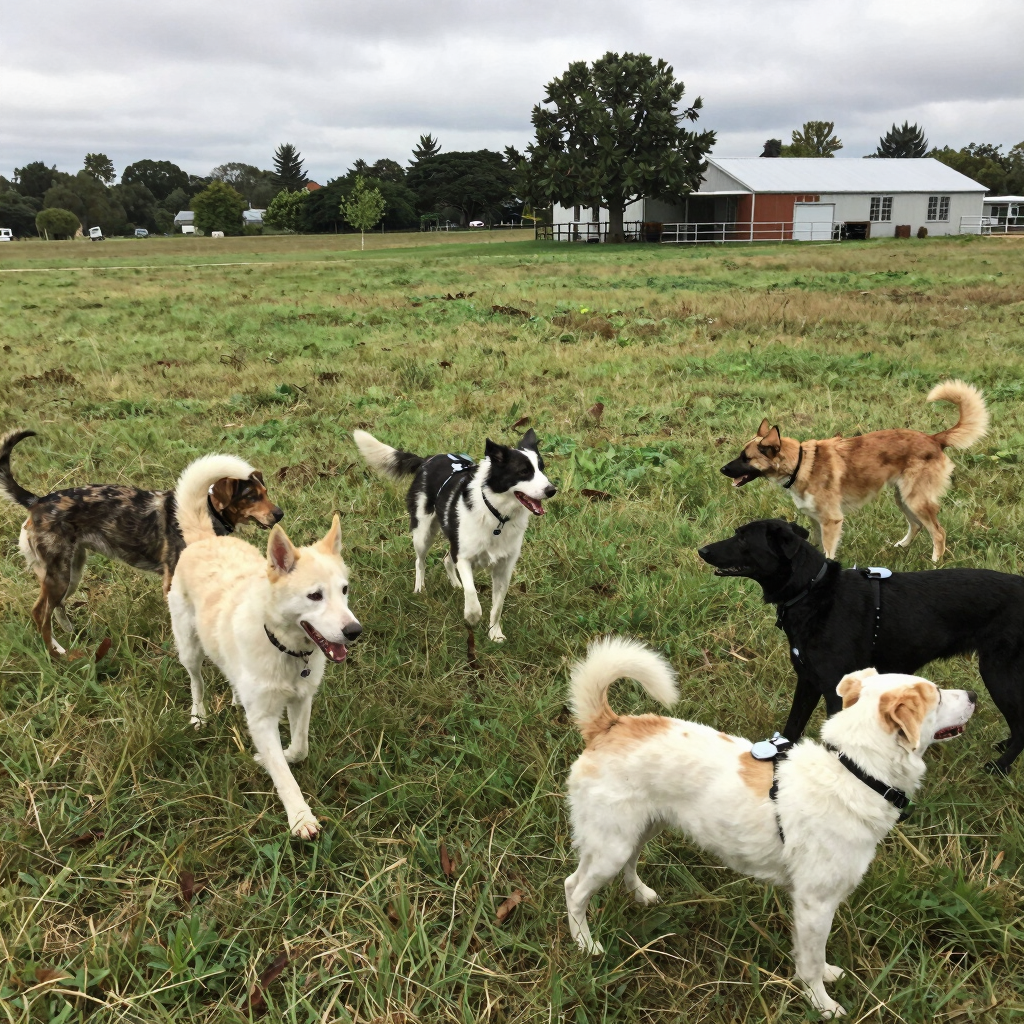
GPS Dog Fence vs Traditional Fence: An Honest Side-by Side Comparison
Keeping your dog safely contained is one of the most important decisions you make as a dog owner. For decades, the answer was simple: build a fence. Wood, chain-link, or vinyl — pick your material, pay for installation, and your yard is secure.
That is no longer the only option — and for a growing number of dog owners, it is no longer the best one.
GPS dog fences use satellite technology and smart collars to create invisible boundaries your dog is trained to respect. No posts, no panels, no construction crews. The boundary exists in software, adjustable from your phone in minutes.
But "no physical barrier" is also the most legitimate concern about GPS fencing. A fence you can see stops a dog. A boundary a dog is trained to respect requires the dog to actually respect it.
This guide gives you an honest comparison of both systems across every dimension that matters — cost, safety, dog suitability, property type, and long-term practicality — so you can make the right call for your specific situation.
🐕 See why thousands of dog owners are switching to GPS fencing.
Already leaning toward GPS? 📖 Want a deeper breakdown?Read our full Halo 3 Wireless GPS Fence Review → for hands-on performance data.
How Each System Works
Traditional Fence
A physical fence creates a hard perimeter around your yard using wood, chain-link, aluminum, or vinyl panels secured with posts. The dog cannot exit the yard because a physical barrier prevents it. No training is required beyond teaching the dog not to jump or dig — though neither is guaranteed with all breeds.
GPS Dog Fence
A GPS fence pairs a smart collar with a smartphone app. You draw a custom boundary on a map — your yard, a section of your property, or anywhere you want your dog to stay. When the dog approaches the boundary edge, the collar delivers a progressive warning sequence: first an audible tone, then vibration, then a mild static correction if the dog continues moving toward the boundary.
Over several training sessions, the dog learns to turn back at the audio warning before the correction is ever needed. Most GPS fence manufacturers provide structured training programs — typically 1–3 weeks — to establish this behavior reliably.
Full Pros and Cons Comparison
GPS Dog Fence Pros
✅ Lower upfront cost ($200–$700 vs. $2,000–$10,000+ for traditional fencing)
✅ Self-installation in under 30 minutes
✅ Works on large properties and acreage
✅ Fully portable for travel, camping, or moving
✅ Not affected by most HOA or fence permit restrictions
✅ Real-time GPS tracking on many models
✅ Boundaries can be adjusted anytime through a mobile app
✅ Continues working during power outages with battery-powered collars
GPS Dog Fence Cons
❌ No physical barrier to stop a dog from leaving
❌ Does not prevent other animals from entering the property
❌ Requires consistent training (typically 1–3 weeks)
❌ Ongoing costs may include subscriptions and collar charging
❌ Effectiveness depends on the dog's temperament and training
❌ Some dogs may ignore corrections when highly distracted
Traditional Fence Pros
✅ Creates a physical barrier that clearly contains dogs
✅ Prevents most outside animals from entering the yard
✅ Requires little to no training
✅ Works for nearly all dogs regardless of temperament
✅ No apps, subscriptions, or battery charging required
✅ Functions continuously without relying on electronics
Traditional Fence Cons
❌ High installation cost ($2,000–$10,000+)
❌ Professional installation often takes 1–3 days
❌ Costs increase significantly on larger properties
❌ Permanent and not portable
❌ May require HOA approval or permits
❌ Boundary location cannot be easily changed
❌ Requires ongoing maintenance, repairs, staining, or panel replacement
Cost: The Widest Gap Between the Two Options
This is where the comparison is most lopsided — and where GPS fencing wins most decisively for budget-conscious owners.
Traditional Fence Costs
A wood privacy fence for a standard suburban backyard (roughly 150 linear feet) costs between $3,000 and $6,000 installed in most U.S. markets, including materials and labor. Chain-link runs slightly cheaper; vinyl and aluminum cost more. Larger properties compound the cost dramatically.
Add HOA permit fees, any required surveys, and the ongoing maintenance costs — painting, staining, replacing rotted posts, fixing storm damage — and a traditional fence is a multi-thousand-dollar commitment that depreciates over time.
GPS Fence Costs
Most quality GPS dog fence systems, including the Halo 3, cost $300–$700 upfront for the collar and base system. Some require a monthly subscription ($10–$30/month) for GPS connectivity and app features. There is no installation cost, no permit, and no construction.
For a half-acre property, a GPS fence costs roughly 5–15% of what a traditional fence would cost to install. For larger rural properties — 2 acres, 5 acres, 10 acres — the traditional fence option often becomes financially impractical, while GPS fencing scales at no additional hardware cost.
Safety: The Most Important Question
No comparison of dog containment systems is honest without directly addressing safety, because this is where the two options diverge most significantly in principle.
What a Traditional Fence Guarantees
A physical fence stops a dog from leaving the yard regardless of the dog's behavior. A determined Husky, a ball-obsessed Border Collie, or a dog that has spotted a squirrel on the other side does not get through a solid wood fence by running at it. The barrier is physical, and physical force is required to defeat it.
This is the irreplaceable advantage of traditional fencing. It does not require anything from the dog except the inability to jump over or dig under the barrier.
What a GPS Fence Requires
A GPS fence works through learned behavior. A properly trained dog stops at the boundary because experience has established that approaching the edge triggers an uncomfortable warning. Well-trained dogs maintain this reliably — but the system depends entirely on the training being solid and the dog's in-the-moment impulse control remaining intact.
This breaks down in predictable scenarios:
High prey drive situations. A dog that spots a rabbit, squirrel, or another dog across the boundary may be sufficiently aroused to push through the static correction. Some dogs will do this once and re-learn the lesson; others will do it repeatedly.
Fearful dogs. In rare cases, dogs may associate the correction sound with being outdoors rather than with the boundary, leading to anxiety around yard time.
Puppies under 6 months. Most GPS fence manufacturers explicitly recommend against use on very young puppies, both for safety and because the behavioral conditioning has not yet developed sufficiently.
The honest summary: For a calm, food-motivated, or handler-focused dog with consistent training, a GPS fence is safe and effective. For a high-drive dog, a reactive dog, or a dog that has already demonstrated boundary-testing behavior, a physical fence or a GPS fence combined with physical barriers in high-risk areas is the safer configuration.
💰 Want the GPS fence we recommend most?
✅ Covers large properties
✅ Easy setup
✅ Real-time GPS tracking
Where GPS Fencing Clearly Wins
Large and Rural Properties
Fencing five acres of land with traditional materials costs $15,000–$40,000+ depending on terrain and materials. GPS fencing covers the same area with no additional hardware investment. For farms, rural homesteads, and large suburban lots, this comparison is not close.
Renters and HOA-Restricted Neighborhoods
Many rental agreements prohibit permanent structures. Many HOAs restrict fence heights, styles, or materials — or prohibit fencing entirely in front yards. A GPS fence has no visible footprint and requires no permits, making it the only viable containment option for a significant portion of dog owners.
Portability
A GPS fence travels with you. If you move, the system moves. If you take your dog to a family member's house for a holiday weekend, you can establish a temporary boundary on arrival in under 10 minutes. No traditional fence offers this.
Real-Time GPS Location Tracking
Most GPS fence systems include live location tracking as part of the app feature set. If your dog does exit the boundary — whether through a gate left open, a fence failure, or a testing incident — you know immediately and have a real-time location on your phone. Traditional fences offer no equivalent.
Where Traditional Fencing Clearly Wins
Complete Physical Security
A traditional fence physically prevents exit and physically prevents other animals, strangers, or threats from entering. It does not require the dog to make a behavioral decision. This is particularly valuable for dogs with high reactivity, dogs recovering from trauma, or properties where the risk of an external threat (wildlife, traffic) is significant.
No Training Dependency
Traditional fencing works on day one with zero training investment. For new dog owners, owners of rescue dogs with unknown behavioral histories, or households where consistent training is difficult to maintain, this reliability is genuinely important.
Multi-Pet and Multi-Threat Scenarios
A traditional fence keeps your dog in and other animals out — coyotes, stray dogs, wildlife. GPS fencing only addresses one half of this equation. In rural areas where wildlife encounters are a real risk, a physical perimeter has safety value that GPS fencing cannot replicate.
Which Is Right for Your Dog?
Use this as a quick decision guide:
GPS fence is likely the better choice if:
Your property is large or awkward to fence physically
You rent or have HOA restrictions
Your dog is calm, trainable, and not high-drive
You move frequently or want portability
Budget is a significant factor
You want real-time location tracking alongside containment
Traditional fence is likely the better choice if:
Your dog is high-drive, reactive, or has a history of boundary-testing
You have young children who need a secure play area
Wildlife or other animals entering the yard is a concern
You want zero dependency on technology or training
Your yard is small enough that traditional fencing is cost-practical
Both together is often the best answer — a physical fence for the core yard area and a GPS collar for real-time tracking and alert notifications when a gate is left open or when traveling.
Frequently Asked Questions
Can a dog run through a GPS wireless fence? A dog that has not been properly trained, or one with very high prey drive in a high-arousal moment, may push through the correction boundary. Consistent training using the manufacturer's program significantly reduces this risk, but it cannot be guaranteed for every dog in every situation.
How long does GPS dog fence training take? Most manufacturers recommend a structured 1–3 week introduction program. Dogs vary — food-motivated, handler-focused dogs often learn reliable boundary behavior in 5–7 days; more independent or stubborn dogs may take 2–3 weeks of consistent sessions.
Do GPS dog fences work in rural areas without cell service? GPS functionality itself relies on satellite signals, not cell service, so boundary enforcement typically works in rural areas. App features, live tracking, and alerts usually require cellular or Wi-Fi connectivity. Check the specific model's offline functionality before purchasing.
Are GPS dog fences cruel? Modern GPS fence systems use progressive correction — tone first, then vibration, then a mild static correction. The static level is adjustable and comparable to the sensation of a static shock from a doorknob. Most dogs respond to the tone alone after training and rarely experience correction. It is not considered cruel by veterinary behaviorists when used as directed with proper training.
What is the best GPS dog fence for large properties? The Halo 3 is one of the most capable GPS fence systems available, with reliable satellite accuracy and a well-structured training program. Read our full Halo 3 Wireless Fence Review → for a complete breakdown.
Can I use a GPS fence alongside a traditional fence? Yes — and for many owners this is the optimal setup. The physical fence provides the hard containment barrier; the GPS collar provides real-time location tracking and alerts if the dog exits through an open gate.
🐕 Ready to Give Your Dog More Freedom?
If you're looking for a GPS fence that's easy to set up, works on large properties, and includes real-time tracking, the Halo 3 is our Pet Ecosystems recommendation.
👉 Check the Latest Price on Amazon
⭐ Read Reviews
📦 See Current Deals
🐾 Start Training in Days
Final Thoughts
The GPS dog fence vs traditional fence comparison does not have a universal winner — it has a winner for your specific situation.
Traditional fencing is more reliable for high-drive dogs, provides a physical barrier that stops other animals, and requires no technology dependency. It is also expensive, inflexible, and impractical on large properties.
GPS fencing is significantly cheaper, fully portable, works on any property size, and adds real-time tracking that traditional fencing cannot offer. It requires training investment and does not physically stop a determined dog.
For most suburban dog owners with a trainable dog and a mid-sized yard, either option works. For large property owners, renters, or anyone dealing with HOA restrictions, GPS fencing is often the only practical option. For owners of high-drive or reactive dogs, a physical fence — or a combined approach — remains the safer choice.
Ready to see how the leading GPS fence performs in real-world testing? See the Halo 3 GPS Fence on Amazon.Read our full Halo 3 Wireless GPS Fence Review
Related: Fi Series 3 GPS Dog Collar Review · Dog Guide
Affiliate disclosure: Pet Ecosystems participates in affiliate marketing programs. We may earn commissions from qualifying purchases made through links on this site at no additional cost to you. Our recommendations are based on independent research and editorial review.